
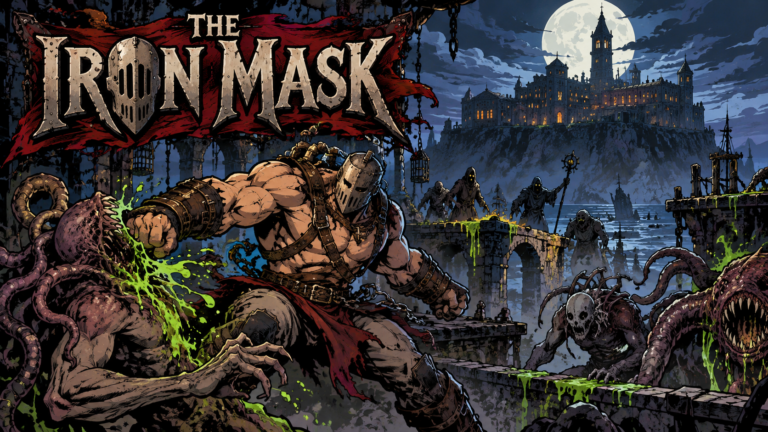
The Iron Mask
Build a short, complete hand-drawn 2D horror brawler / Metroidvania in Godot: a roughly four-level “Chapter One” that feels like the kind of substantial shareware episode that leaves you wanting the rest. The player is the historical Man in the Iron Mask, reimagined through Renegade Realms’ history-adjacent lens as a prisoner subjected to proto-biological and occult experimentation on Poveglia Island.
Core fantasy
The Iron Mask should feel deliberately overpowered. Combat is about smashing grotesque monsters into paste, punching creatures apart, throwing bodies, brutal grapples and executions, environmental kills, counters, weapons, combos, and increasingly monstrous special abilities. The touchstones are Splatterhouse and Castlevania: Symphony of the Night: savage horror-brawler impact married to exploration, progression, secrets, backtracking, and build development.
The mask and transformation
The iron mask is a steampunk/proto-industrial injection apparatus: tubing, valves, needles, pressure chambers, and chemical reservoirs built into the prisoner’s restraint. It periodically injects him on a timer, whether he wants it or not. The player can also deliberately trigger different compounds at tactically useful moments. The compounds amplify strength and mutation and can support different combat states or abilities.
Across the chapter, the prisoner becomes visibly larger and increasingly vascular. Optional mutation trees can push him further into body-horror evolution: bone plating, spikes, claws, and other combat adaptations. The transformation should be reflected in both mechanics and presentation, including his voice becoming progressively more monstrous as the story advances.
Historical-horror premise
Keep the game heavily adjacent to real history, consistent with the wider Renegade Realms approach. The public historical record says one thing; the hidden history sends the prisoner to Poveglia Island as part of secret experimentation. Earlier development also explored the identity of the prisoner through the Philippe / Louis XIV twin tradition while preserving the larger historical mystery. Historical facts, figures, places, technologies, rumours, and gaps should provide scaffolding wherever possible, with the supernatural and proto-scientific conspiracy living inside those gaps.
The responsible alchemist / natural philosopher and his circle are attempting to use emerging science, chemistry, physiology, machinery, and experimentation to amplify occult ritual. Their work tears open a rift and turns the prison complex into a biological and cosmic nightmare. The antagonist’s final identity and name remain unresolved and should be recovered from Brent’s older notes rather than invented casually.
Enemies and horror
Use the full Lovecraftian toybox with aggressive body horror and very little interest in subtlety. Possessed guards and prisoners should be physically transformed rather than merely spooky: heads replaced or controlled by puppeteer-like spiders, parasites erupting through hosts, grotesque anatomical restructuring, and other visible mechanisms of possession. Add mutated island animals, cultists, infected prisoners and staff, parasitic organisms, extradimensional creatures, and larger cosmic horrors. Gore, slime, mutation, viscera, and spectacular monster destruction are part of the game’s identity.
Story arc
The immediate motivation is revenge against the people who imprisoned and experimented on the protagonist. That revenge carries him deeper into the catastrophe, where he discovers the rift and realizes it must be stopped before he can escape. Chapter One therefore moves through three escalating drives: revenge, stop the rift, escape.
Favor environmental storytelling throughout the island: abandoned laboratories, cells, machinery, failed experiments, ritual spaces, corpses, architecture, and environmental changes should tell much of the story without interrupting play. Journals and documents can be discovered in a BioShock-like audio-log role, with the Iron Mask himself reading the material aloud. His narration gradually becomes deeper and more monstrous as his transformation progresses. Occasional cutscenes are welcome; QTE-heavy storytelling is not.
Chapter One target
Create approximately four interconnected levels with a small quest line, exploration and Metroidvania-style gating, meaningful upgrades or mutation choices, several enemy families, memorable set pieces, bosses, secrets, and a complete mini-arc. It should stand as a downloadable finished game while clearly feeling capable of expanding into later chapters.
Development approach
Build in Godot through iterative “vibe coding” between Brent and Ari. Ari can develop code, systems, prototypes, and visual assets; Brent directs the concept and checks visual/gameplay style as development proceeds. Target a hand-drawn 2D presentation rather than the earlier browser prototype’s temporary presentation. The existing browser action-platformer work is useful as a mechanical prototype and design experiment, not the final engine target.
Development builds/source can be opened for playtesting and community use under a deliberately limited license. Preserve BrentCorp / Renegade Realms control over the setting, characters, canon, and the right to make official games. Choose the exact open-source/source-available licensing structure before public release rather than assuming a permissive license.
Completion criteria
This quest is complete when The Iron Mask exists as a downloadable finished game: approximately four levels forming a coherent Chapter One, with functioning combat, exploration, mutation/injection progression, enemies and bosses, narrative delivery, finished-enough hand-drawn visual/audio presentation, a beginning-to-end story arc, and a distributable build that other people can actually play.