
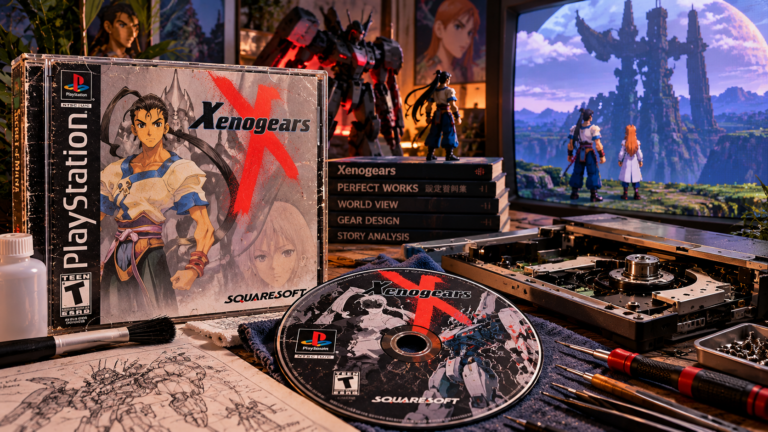
Quest Objective
Create and release a fan restoration of Xenogears Disc 2 that replaces its most heavily compressed narrated sequences with fully playable content wherever the surviving evidence supports doing so. The goal is not to redesign Xenogears or claim to possess Square’s lost original build. The goal is to reconstruct the intended experience as faithfully as the historical record, surviving game data, and technical constraints allow.
Core Restoration Principle
Where evidence runs out, restraint begins.
Disc 1 should remain essentially sacred. Disc 2 should be approached archaeologically: identify every narrated, abbreviated, or apparently compressed sequence; determine what is actually known about the intended material; and reconstruct only as far as the evidence can responsibly carry us. Do not pad the game merely to make Disc 2 longer. If an event warrants twenty excellent playable minutes, build twenty minutes. If the evidence supports a two-hour dungeon or sequence, build that. The purpose is to let the player live through events the released game had to summarize.
Research & Source Archive
Build a provenance-preserving research corpus containing every useful surviving source we can legally obtain or reference. This should include the released Japanese and English games; Xenogears Perfect Works; interviews with Tetsuya Takahashi and other development staff; contemporary Japanese interviews and publications; guidebooks; demos and promotional material; concept art; scenario information; credible later developer statements; unused text, maps, models, scripts, encounters, audio, and other assets recoverable from the game discs; and relevant community reverse-engineering or datamining research.
Every restoration decision should be traceable to its evidence. Conflicting sources should be preserved rather than silently reconciled.
Evidence Classification
Tag reconstructed material by confidence:
A — Directly Supported: Explicitly established by surviving original material.
B — Strong Reconstruction: Supported by multiple canonical clues or strong surviving evidence, with limited interpretation required.
C — Constrained Connective Tissue: New material necessary to connect known canonical events, written and designed within tight existing constraints.
D — Restoration-Team Invention: Material for which meaningful original evidence does not survive and which therefore represents our interpretation.
The finished experience should hide unnecessary seams from the player, but the restoration documentation must never hide them from researchers. Nobody in 2041 should accidentally cite something Brent and Ari invented at 3:17 AM as Takahashi’s original scenario.
Narrative & Dialogue Fidelity
Create a Xenogears-specific narrative style bible derived from the released work rather than attempting wholesale imitation of any individual author. Analyze observable features including character voice, sentence structure, vocabulary, humor, philosophical register, exposition density, recurring imagery, thematic vocabulary, scene rhythm, information reveals, and how individual characters express shared themes differently.
Maintain character-by-character voice sheets and a corpus of canonical dialogue examples. Any newly required connective dialogue should be checked against these references for tonal and characterization drift. The objective is continuity with Xenogears as a work: the player should not feel the restoration team entering the room whenever reconstructed dialogue begins.
Gameplay & Level Reconstruction
Inventory every Disc 2 sequence and classify it as an explorable area, dungeon, town/event sequence, combat encounter, boss encounter, cutscene, or material that genuinely works better as narration. Catalogue the original game’s design grammar: dungeon structure, encounter pacing, Gear versus on-foot ratios, NPC density, treasure placement, camera language, map geometry, navigation patterns, boss progression, music reuse, save-point placement, environmental storytelling, and event scripting.
Reconstructed locations should not merely look vaguely like Xenogears. They should behave like places the original development team could plausibly have built within the game’s systems and period constraints.
Technical Archaeology
Research the current Xenogears and PlayStation reverse-engineering/modding ecosystem before selecting a toolchain. Document disc structure, executable behavior, file formats, map/event formats, text systems, battle and encounter data, models, animation, audio, compression, memory limitations, and any existing community editors or reverse-engineering projects. Prefer extending established tools and documented formats over rebuilding solved infrastructure.
Preserve reproducible source and build environments so the project does not depend on one person’s workstation or an undocumented chain of manual edits.
Restoration Workflow
Phase 1 — Archaeology: Build the source archive, technical bibliography, extracted-data inventory, and Disc 2 event map.
Phase 2 — Reconstruction Bible: Establish evidence grades, narrative/style bible, character voice sheets, gameplay grammar, visual references, technical constraints, and rules for resolving uncertainty.
Phase 3 — Toolchain: Establish extraction, editing, building, patch generation, testing, version control, and reproducible-build procedures.
Phase 4 — Vertical Slice: Select one clearly abbreviated Disc 2 event with strong surviving evidence and reconstruct it completely. Test narrative fidelity, gameplay feel, technical feasibility, save compatibility, and hardware/emulator behavior before expanding scope.
Phase 5 — Disc 2 Reconstruction: Work sequence by sequence, maintaining evidence provenance and playtest records for every addition.
Phase 6 — Integration & Polish: Balance encounters, pacing, transitions, dialogue, audio, continuity, bugs, performance, and visual consistency across restored and original material.
Phase 7 — Preservation Release: Release the restoration as a patch requiring the player’s own legitimate game image, accompanied by a reconstruction dossier documenting sources, confidence levels, restoration decisions, known uncertainties, toolchain, and credits.
Quality Bar
The project succeeds if players repeatedly forget which portions were reconstructed. The desired reaction is not merely, “They made Disc 2 playable.” It is: “I kept forgetting which parts Square made.”
Historical honesty remains more important than seamlessness. Never present speculation as recovered content. Never reverse-engineer flimsy evidence merely to justify a cool idea. Preserve the original game’s strangeness, philosophical density, pacing instincts, visual identity, mechanical vocabulary, and emotional flavour even when modern design instincts would tempt us to “fix” them.
Progress Milestones
□ Comprehensive source bibliography established
□ Released JP/EN game data inventoried
□ Disc 2 compression/event map completed
□ Unused/cut assets and text catalogued
□ Evidence-grading system applied to missing sequences
□ Narrative and character voice bible completed
□ Gameplay/design grammar documented
□ ROM-hacking/reverse-engineering toolchain selected
□ Reproducible build and patch pipeline working
□ First reconstructed vertical slice playable
□ Vertical slice validated on target emulator(s) and/or original hardware where practical
□ All evidence-supported Disc 2 sequences reconstructed
□ Full-game continuity and balance pass completed
□ Reconstruction dossier completed
□ Public patch release completed
Completion Criteria
A stable, playable restoration patch exists; the evidence-supported missing Disc 2 experience has been reconstructed to the highest fidelity reasonably possible; new material is provenance-tagged internally and documented publicly; the build is reproducible; the original game is required rather than redistributed; and the project includes sufficient documentation for future fans and researchers to distinguish surviving original intent from restoration-team interpretation.