
Quest
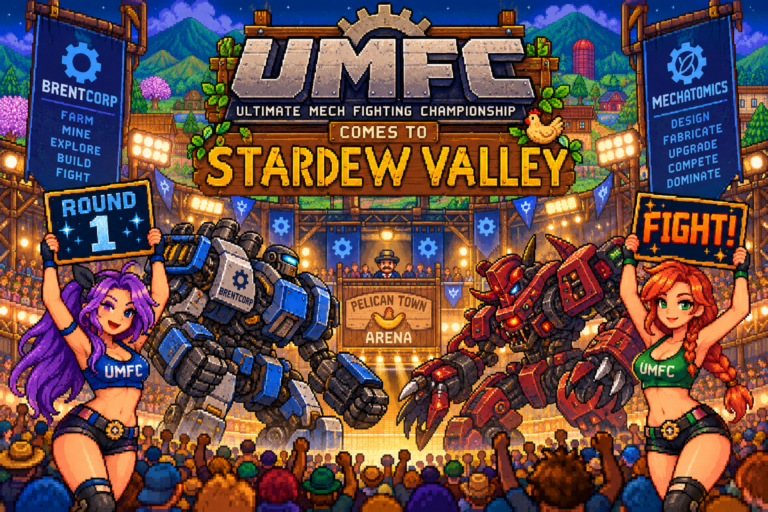
Build a substantial Stardew Valley mod that brings the Ultimate Mech Fighting Championship (UMFC) and MechAtomics into Pelican Town as a playable combat-engineering progression system. The goal is not merely to add a mech costume or isolated arena minigame. It is to make mech design, fabrication, resource production, fighting, repair, salvage, sponsorship, and championship progression feel like a strange but coherent extension of Stardew Valley’s existing farming, mining, crafting, social, and seasonal rhythms.
Core fantasy
Farmer Brent begins as an ordinary farmer and gradually becomes a fabricator, mech engineer, pilot/team owner, and UMFC contender. During normal days the player farms, mines, gathers materials, builds components, tunes machines, repairs damage, and develops relationships. On scheduled fight nights the player brings a custom-built machine into the UMFC arena and discovers whether the engineering actually works.
The intended arc is: farmer → artisan → industrialist → mech engineer → UMFC competitor/team owner → Pelican Town’s alarmingly well-equipped agricultural warlord.
MechAtomics rather than simple equipment tiers
The mech should be assembled from functional systems rather than treated as one equipment item whose number simply increases. Candidate component classes include frame/chassis, actuators, armor, power storage and delivery, cooling, sensors, control systems, mobility systems, melee systems, ranged or utility systems where appropriate, and pilot-support hardware.
Components should create meaningful engineering tradeoffs. Mass affects mobility and stability. Armor improves survivability but adds weight. Stronger actuators consume more power and may generate more heat. Batteries increase endurance but consume mass and space. Cooling allows sustained output but has its own cost. Damage should ideally be regional or subsystem-based so a fight can degrade a machine rather than merely subtracting one universal health bar.
Pelican Town UMFC division
Add a dedicated UMFC arena or event venue to the valley. The first implementation can be deliberately compact: one arena map, several opponents, scheduled fight nights, prize money, rankings, custom loadouts, damage, repair, and a championship progression. Later versions can expand into rival teams, sponsors, belts, weight classes, career records, specialist component manufacturers, underground fights, repair crews, pilot injuries, procedurally generated competitors, and eventually multiplayer if the technical architecture permits it.
Integrate the existing Stardew economy
The mod should reward participation in Stardew’s existing systems rather than replacing them with a separate currency treadmill. Mining supplies metals and minerals. Hardwood and other early materials can support crude frames or armor. Battery Packs become meaningful industrial components. Crystalariums can contribute specialty materials. Slime products can become unusual polymers, lubricants, insulation, coolants, or composites. Sheds can evolve into fabrication workshops. Salvaged UMFC components can be repaired, stripped for parts, or recombined into new builds.
Water wheels: early-game renewable Battery Pack production
Add craftable water wheels or small hydroelectric generators as an early-game route to Battery Packs. The player should not have to rely primarily on farming Iridium Bats or waiting for lightning storms in order to develop an electrical/mechatronics branch of play.
A basic water wheel placed at a valid flowing-water location should generate power continuously or accumulate charge toward Battery Pack production. Balance can be controlled through construction cost, location requirements, generation rate, maintenance, seasonal flow, storage capacity, or the need for an intermediate charger/battery bank. More advanced hydro systems can appear later. The important design principle is that renewable infrastructure should provide a predictable, buildable electrical progression path while lightning rods and monster drops remain useful bonuses rather than mandatory bottlenecks.
NPC integration
The UMFC should feel as though it has arrived in Pelican Town rather than existing behind a disconnected menu. Robin is a natural construction/fabrication connection. Clint’s blacksmithing suddenly becomes strategically important to a combat-robotics economy. Maru is an obvious engineering enthusiast. Sebastian could plausibly become involved with control software or unconventional modifications. Abigail would almost certainly want near the fighting. Mayor Lewis can be forced to confront the municipal consequences of allowing an international mech-fighting league into a farming village.
NPC participation should ultimately include dialogue, reactions to fights, friendship-dependent opportunities, engineering quests, rivalries, spectatorship, and possibly NPC pilots or team members.
BrentCorp integration
The existing BrentCorp Stardew Valley presence can become the industrial bridge into UMFC. BrentCorp can sell or unlock tools, machinery, fabrication infrastructure, upgrades, entry-level mech systems, and eventually specialized MechAtomics components. This gives the BrentCorp storefront a functional purpose beyond visual worldbuilding while tying the mod into the broader BrentCorp/UMFC IP.
Fight design
Combat should reward both piloting and engineering. Different builds should produce genuinely different fighting behavior: heavily armored bruisers, agile machines, reach-focused designs, endurance builds, high-output machines constrained by heat, and improvised salvage monsters. Between rounds or events, damage creates economic and engineering consequences. Winning with a machine that is expensive to repair may be strategically worse than winning efficiently.
Seasonal and career structure
Use Stardew’s calendar as an advantage. UMFC events can occur on scheduled evenings or designated days, allowing the player to prepare between fights. A season can function as a miniature competitive circuit culminating in a championship event. Long-term progression can introduce increasingly sophisticated opponents and engineering requirements without turning every normal farm day into combat.
Emergent expansion possibilities
Future systems may include sponsors with requirements and benefits; rival engineering teams; component wear and reliability; salvage markets; named machines with persistent records; pilot reputations; commentary; crowd reactions; underground sewer fights; special exhibition matches; NPC-built machines; championship trophies; fabrication contracts; and crossovers with other BrentCorp technologies.
MVP
The first playable vertical slice should stay brutally focused:
- SMAPI mod loads reliably.
- One UMFC arena/event map.
- One player mech with several interchangeable component choices.
- A small but real power/mass/armor/mobility tradeoff model.
- At least several AI opponents with visibly different builds or fighting behavior.
- Damage, victory/defeat, prize money, and post-fight repair.
- A basic ranking or championship progression.
- At least one BrentCorp fabrication/crafting interface.
- A working water-wheel-to-electrical-storage/Battery-Pack progression loop.
If this slice makes the player spend a Stardew day gathering and fabricating parts because they are genuinely excited about the next fight, the core loop works.
Technical philosophy
Keep the first architecture modular and easy to iterate. Separate simulation/state for mech components from rendering and combat presentation so MechAtomics can grow without rewriting everything. Data-drive component definitions where practical. Preserve save compatibility wherever possible. Treat the Stardew mod as both a fun standalone project and a low-cost playable prototype for mechanics that may later inform a standalone UMFC game.
Why this matters
This project can do three jobs at once: create an unusually ambitious Stardew Valley mod, turn the BrentCorp storefront into a meaningful gameplay system, and prototype UMFC/MechAtomics mechanics inside an existing game loop before committing to a standalone title. The tonal collision is also part of the appeal: a cozy farming village gradually becoming home to a serious modular mech-fighting league should remain funny without making the engineering shallow.
Definition of success
The quest succeeds when UMFC feels native enough to Stardew’s progression that farming, mining, crafting, relationships, fabrication, and fight preparation feed one another, while the combat and engineering are deep enough that players develop attachment to specific machines and stories about how they were built, damaged, rebuilt, and eventually became champions.