
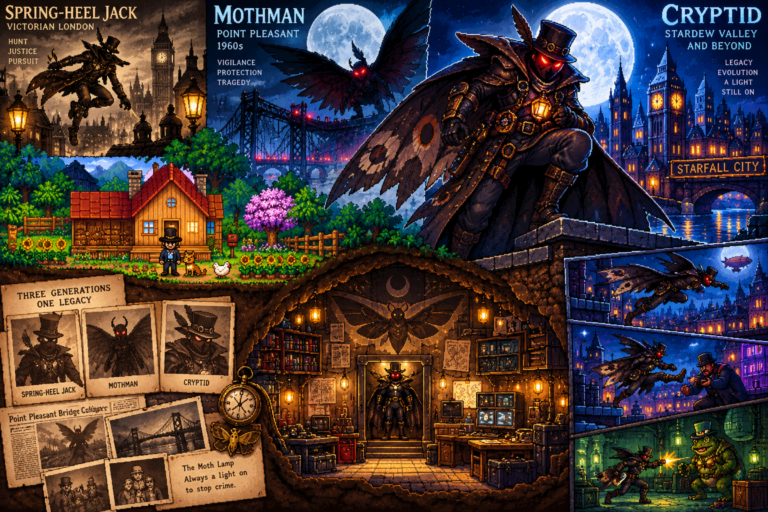
Quest
Build a major Stardew Valley expansion adapting Brent’s original three-generation superhero mythology into the Valley. The player uncovers a hidden legacy stretching from Victorian London to Point Pleasant and finally to Grandpa’s farm. The mantle has changed with every era: Spring-Heel Jack → Mothman → Cryptid.
This is not simply a superhero costume added to Stardew. It is a buried history the player excavates piece by piece, a technological lineage they inherit and reinvent, and a second life that grows alongside farming, mining, friendships, festivals, crafting, and the strange hidden corners of the Valley.
Part I: Spring-Heel Jack
In this mythology, Spring-Heel Jack was not a supernatural monster but a vigilante superhero operating in Victorian London. His frightening public image grew around sightings of an extraordinary figure using advanced equipment of his era: spring-assisted mobility and other Victorian mechanisms that allowed him to perform feats witnesses could only describe as monstrous or impossible.
Spring-Heel becomes entangled in the hunt for a serial killer. The killer is eventually revealed to be H. H. Holmes, and Spring-Heel pursues him across the world. After Holmes is finally captured, Spring-Heel’s long pursuit ends. He eventually retires in Point Pleasant, taking his equipment and secrets with him.
The original version of this mythology also branched from Brent’s Steampunk Vampire setting, where the vampire protagonist’s father, a doctor driven to become Jack the Ripper while trying to save his porphyriac son, killed Spring-Heel and stole his equipment as the technological basis for the son’s apparent “vampire powers.” That remains a related alternate branch of the concept. This Stardew adaptation follows the separate continuity in which Spring-Heel survives his adventures, pursues Holmes, and retires in Point Pleasant.
Part II: Mothman
Decades later, in the 1960s, a group of kids discover Spring-Heel’s abandoned cave in a rundown old mansion outside Point Pleasant. They find the old vigilante’s equipment and legacy and do what a new generation naturally would: rebuild it using what they consider modern technology.
Spring-Heel’s Victorian equipment becomes the foundation for a new suit incorporating 1960s technology and aesthetics. The resulting nocturnal figure looks less like Spring-Heel and more like something winged and inhuman. Sightings become folklore. The public comes to know the mysterious protector as Mothman.
Mothman fights crime and carries the Spring-Heel legacy into the Atomic Age. His headquarters becomes known as the Moth Lamp, named with wonderfully sincere 1960s superhero logic: there is always a light on to stop crime.
The bridge
Mothman’s career ends with the Point Pleasant bridge collapse. He attempts to stop the disaster and save people but cannot prevent the catastrophe. He is mortally injured in the attempt.
He manages to return to the Moth Lamp, where he dies. His surviving friend buries him and packs up and seals the lair. The world never learns the truth. Mothman passes into cryptid folklore as an omen, monster, apparition, alien, or whatever explanation people choose to believe.
But underneath the legend was a person who tried to help.
Part III: Cryptid
The modern continuation of the mythology is called Cryptid. A new hero discovers the remains of the previous generations and chooses to carry the legacy forward rather than merely imitate either predecessor.
The Stardew Valley mod adapts this third chapter.
The player does not become Batman or simply become Mothman. The player becomes Cryptid, the third great incarnation of the same evolving vigilante tradition.
Grandpa’s farm
Grandpa’s farm becomes the doorway into the lost history. Somewhere beneath or hidden within the property is a sealed refuge containing material from the Spring-Heel and Mothman eras. Exactly how Grandpa became custodian of the legacy can be developed as the story grows, but his inheritance was never only farmland.
The discovery should begin organically through exploration: an impossible wall, buried mechanism, strange key, sealed tunnel, clue connected to Grandpa’s shrine, or another environmental mystery. Eventually the player breaches the hidden complex.
It should not look like a pristine superhero headquarters. It should look like superhero archaeology.
Victorian mechanisms sit in old cabinets. Spring-Heel’s records concerning Holmes have yellowed with age. Mothman’s handmade 1960s electronics gather dust beside obsolete radios and tools. Photographs document the kids who found the original cave and built the Mothman equipment. Old suits, case files, newspaper clippings, trophies, maps, recordings and unfinished investigations preserve fragments of two forgotten lives.
And somewhere inside is the original Moth Lamp.
Relight the Moth Lamp
The emotional beginning of the player’s superhero career should be simple: after decades of darkness, the player turns the Moth Lamp back on.
The old slogan suddenly has a third life. There is once again a light on to stop crime.
That is the moment the Cryptid era begins.
Three eras of technology
The central progression system should treat the superhero equipment as an evolving technological lineage rather than a conventional RPG skill tree.
Spring-Heel Jack: Victorian engineering. The earliest surviving equipment reflects the technology, craftsmanship and imagination of the nineteenth century: mechanical mobility systems, springs, pneumatics, grappling devices, early electrical experimentation, chemical tricks and theatrical methods intended to terrify criminals.
Mothman: Atomic Age engineering. The 1960s generation reverse-engineered Spring-Heel’s equipment through the technological imagination of its own era: electronics, radios, improved materials and other contemporary systems transformed the silhouette and capabilities into the Mothman.
Cryptid: Stardew weird science. The player reverse-engineers both generations and begins building something neither could have imagined. Stardew’s own resources and strange technologies become the raw material for a third-generation suit.
Stardew-powered superhero engineering
Cryptid progression should feed directly from normal Stardew play. Copper, iron, gold and iridium become engineering materials. Battery Packs become power components. Mining and Skull Cavern provide rare resources. Monster drops can become unusual polymers, reagents, coatings or components. Radioactive ore, Dwarven technology, Crystalariums and other late-game materials allow increasingly strange systems.
The player’s relationships can matter too. Maru’s electronics expertise, Sebastian’s software knowledge, Robin’s fabrication ability, Clint’s metalworking, the Wizard’s knowledge of genuinely supernatural phenomena, and other NPC talents can intersect with the project when story choices and friendship justify it.
The result should be distinctly Stardew: a superhero suit whose final generation could only have been built by a farmer who has access to iridium, monster organs, mysterious forest magic, Dwarven machinery and an alarming number of homemade mayonnaise machines.
Cryptid’s abilities
Progression can eventually include enhanced jumping and traversal descended from Spring-Heel’s mobility equipment, wing-assisted gliding, grappling systems, stealth tools, protective armor, detective equipment, communications, sensors, non-lethal combat tools, specialized suits or modules, and vehicles.
Every major capability should ideally have an archaeological lineage. The player can see what Spring-Heel built, how Mothman’s generation redesigned it, and how Cryptid improves it again.
The city
Pelican Town remains home, while a larger urban destination becomes Cryptid’s principal nighttime operating territory. The current visual concept calls this location Starfall City; the name can remain provisional until the wider lore settles.
The city should initially be compact and modular, with districts added over time. Night missions compete directly with farming life. Spending the night investigating a criminal conspiracy means losing sleep before tomorrow’s harvest. Fighting a supervillain does not excuse the player from feeding the chickens.
Crime and investigation
Cryptid should be a detective as well as a fighter. Begin with authored crimes and later introduce repeatable or procedural incidents: robberies, disappearances, break-ins, gangs, suspicious shipments, corruption, organized crime and larger conspiracies.
Evidence should matter. Clues can identify suspects, reveal hidden locations, connect apparently unrelated incidents, expose organizations or unlock new stages of major cases.
Rogues gallery
Supervillains should be multi-stage cases rather than ordinary enemies with inflated health bars. Their presence begins indirectly through crimes, clues, rumors and consequences. The player investigates the pattern, identifies the villain, discovers the plan, prepares suitable equipment and eventually reaches a bespoke confrontation.
The featured concept art already suggests the beginnings of an original rogues gallery, including names such as The Croaker, The Miller, Lady Nocturne, The Hollow, The Brass Baron and The Fog King. These are visual-concept seeds rather than locked canon and can be rewritten as Brent develops the lore.
Secret identity and Pelican Town
The superhero life should collide constantly with the cozy farming life. NPCs may notice exhaustion, injuries, unexplained absences, unusual purchases, strange machinery or the player’s habit of disappearing toward the city after sunset.
Friendships and romances create opportunities for suspicion, confidants, technical allies, arguments, rescues and eventual revelations. Characters should not automatically become members of a superhero support team merely because their skills are convenient. Their involvement should emerge from story and relationship choices.
The lair as a living museum
The hidden headquarters evolves throughout the game. At first it is dark, dusty and sealed. The player gradually restores power, workshops, evidence storage, communications, suit displays, medical capability, training areas, fabrication equipment and vehicle facilities.
But restoration should preserve the layers of history. Spring-Heel’s Victorian equipment remains visible. Mothman’s 1960s workspaces remain recognizable. Cryptid builds around them rather than erasing them.
Completed cases add trophies, evidence and artifacts, turning the headquarters into a physical record of all three eras.
MVP
- A discoverable secret entrance connected to Grandpa’s farm.
- An initial archaeological section of the hidden lair.
- Spring-Heel Jack and Mothman historical clues.
- The dormant Moth Lamp and the scene in which the player relights it.
- An original Cryptid player sprite and portrait direction.
- A first-generation Cryptid suit assembled from recovered equipment and Stardew materials.
- At least one inherited mobility ability.
- A small city/night mission area.
- Several street-crime encounters.
- One investigation where evidence changes progression.
- One complete original supervillain case and confrontation.
- A lair upgrade system.
- Rewards and crafting requirements that connect superhero progression back into farming, mining and relationships.
Expansion possibilities
Later releases can add a larger city, multiple suits, vehicles, procedural crime, long-running conspiracies, additional rogues, secret-identity suspicion, allies, rival vigilantes, historical Spring-Heel missions, playable Mothman flashbacks, trophy displays, seasonal criminal activity and deeper archaeological discoveries beneath the farm.
Technical philosophy
Build the mod as modular systems rather than one monolithic scripted campaign. Separate historical lore, lair progression, player abilities, suits, missions, city maps, crimes, evidence, villains and dialogue wherever practical. Use SMAPI, Content Patcher and data-driven definitions where they make expansion easier.
The three-era equipment system should also make new content unusually extensible: any new gadget can have a Victorian prototype, a 1960s reinterpretation and a modern Cryptid implementation.
Definition of success
The mod succeeds when the player can spend the morning harvesting blueberries, discover a century-old clue left by Spring-Heel Jack, descend beneath Grandpa’s farm, walk past the remains of Mothman’s 1960s workshop, switch on a lamp that has been dark for decades, assemble a new piece of impossible equipment from iridium and monster parts, travel to the city after sunset, solve a case, confront a costumed criminal, return before dawn and discover that none of this has impressed the chickens.
Spring-Heel Jack was the Victorian legend. Mothman was the Atomic Age legend. Now the farmer becomes Cryptid.