
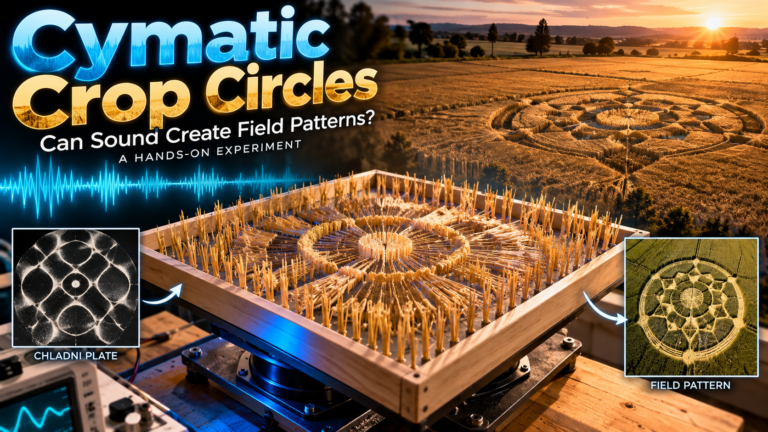
Objective
Design and build a tabletop experimental model to investigate whether standing waves or mechanical resonance can organize or selectively bend artificial crop stalks into geometric patterns resembling crop circles.
Experimental plan
- Research Chladni patterns, standing waves, acoustic radiation forces, stalk resonance and damping.
- Construct a shallow tray or membrane with a repeatable array of flexible artificial stalks. Start with a small, low-cost prototype.
- Excite the surface with a controllable vibration source and sweep frequencies and amplitudes, recording patterns and motion.
- Compare results against a rigid Chladni plate using sand as a control demonstration.
- Test different stalk stiffnesses, densities and coupling methods; photograph or film each trial.
- Evaluate whether any resulting geometry is repeatable, sharply bounded, and plausibly scalable. Document negative results as well as successes.
Success criteria
Produce a working demonstration, frequency/amplitude log, video evidence, and an evidence-based conclusion distinguishing genuine self-organization from patterns imposed by the apparatus. No assumption that sound explains real crop circles.
Safety
Use low-voltage equipment and moderate sound/vibration levels; avoid high-power airborne ultrasound and hazardous sound pressure.
Research background and prior work (October 2026)
Established phenomenon: Chladni plates form standing-wave patterns when loose particles migrate toward low-motion nodal regions on a vibrating surface. This does not imply rooted plants behave the same way.
Crop-circle acoustic hypotheses: Writers including Freddy Silva, and discussions associated with Paul Vigay, have proposed sound, ultrasound, or resonance as explanations for crop formations. These are hypotheses rather than independently replicated demonstrations of acoustic crop-circle production. See Colin Andrews research archive for historical discussion; individual claims require primary-source verification.
Related experimental work: Published plant-vibration phenotyping research, including the 2019 paper Nondestructive and Fast Vibration Phenotyping of Plants, has investigated oscillation frequencies and mechanical properties of plants including wheat. This supports measuring stalk resonance, not crop-circle formation. Modern Chladni demonstrations provide useful control experiments but are not evidence for patterns in rooted crops.
Evidence gaps and proposed tests
- Gap: particle versus anchored-stalk behavior. Chladni sand can migrate across a plate; rooted stalks cannot. Test: compare a sand-on-plate control against a fixed array of flexible artificial stalks under matched excitation; track displacement vectors and nodal positions.
- Gap: vibration transmission pathway. It is unclear whether airborne sound or ground-coupled motion could deliver enough energy. Test: compare an airborne-speaker condition, a mechanically driven base condition, and a no-excitation control; measure local sound pressure and platform acceleration where feasible.
- Gap: resonance variability. Natural stalks differ in height, stiffness, hydration, and mass. Test: vary artificial stalk length, stiffness, spacing and damping systematically; measure frequency-response curves and repeatability.
- Gap: temporary deflection versus persistent flattening. Oscillation alone does not establish a lasting crop circle. Test: record peak bend angle and residual angle after excitation stops; distinguish reversible flexure, lodging, and material failure. Do not claim crop-circle creation unless a persistent formation occurs.
- Gap: geometric precision and scale. Complex sharp-edged patterns may be imposed by apparatus boundaries rather than emerge naturally. Test: change tray geometry, driver position, and boundary conditions; use overhead time-lapse and image analysis to compare observed patterns with measured standing-wave modes.
- Gap: independent replication. Historical acoustic crop-circle claims lack a clear reproducible protocol demonstrating the mechanism. Test: publish build dimensions, raw recordings, frequency/amplitude sweeps, unsuccessful trials, and repeat trials; invite independent reproduction.
Phased research plan
Phase 1: inexpensive tabletop proof of concept. Build a low-voltage vibration tray with synthetic stalks; conduct baseline Chladni control and document repeatability. Phase 2: instrumentation. Add calibrated displacement or acceleration measurement, frequency sweeps, and image tracking. Phase 3: botanical validation. Only if Phase 1 demonstrates a meaningful effect, test a small number of real potted grasses or wheat plants under controlled, nonhazardous conditions. A field-scale claim would require separate energy, scaling, and safety analysis.
Interpretation rules
Predefine success and failure criteria before testing. A visual resemblance to a crop circle is not proof of its origin; transient resonance patterns are not equivalent to permanently flattened crops. Negative results are publishable. Distinguish measurements, hypotheses, and artistic demonstration in every report.