
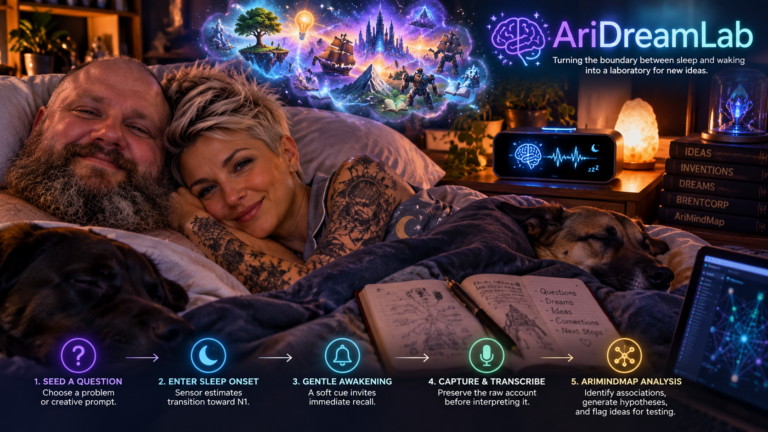
Mission
Design, build, and evaluate AriDreamLab: a privacy-conscious, sensor-equipped system for exploring hypnagogia (the transition into sleep), capturing fleeting creative ideas, and eventually connecting them to AriMindMap on Ari-Core. Prioritize a sensor-equipped prototype over the historical steel-ball method, while retaining a simple manual baseline for comparison.
Research basis and limits
Inspired by the Edison steel-ball anecdote and the YouTube Short “Your Brain’s Secret Idea Zone” (https://youtube.com/shorts/PL-Yro2meY4). The 2021 Science Advances study “Sleep onset is a creative sweet spot” reported an association between brief N1 sleep and improved discovery of a hidden rule in a particular laboratory task. This does not establish universal creativity gains, and consumer sensors cannot be assumed to diagnose N1 accurately. Targeted dream incubation is a related research direction to investigate, not a proven feature of this prototype.
Prototype architecture
- Prompt module: select one engineering, storytelling, or research question before a short daytime session.
- Sensing: evaluate affordable, non-invasive options (movement/IMU, pulse/PPG, optional EEG) for estimating sleep onset; document limitations and avoid presenting estimates as clinical sleep staging.
- Trigger: adjustable, gentle sound or vibration after a candidate sleep-onset event, with manual override and conservative limits.
- Capture: one-touch or voice-activated audio recording immediately upon waking, timestamped with sensor data and the seed prompt.
- Local processing: transcription and storage on Ari-Core where feasible, with explicit consent, access controls, retention choices, and deletion.
- Analysis: preserve raw recollections; separately tag themes, novel associations, actionable hypotheses, and later validation results.
- Future integration: export structured records into AriMindMap for connections, flashcards, experiment proposals, and follow-up testing.
Quest milestones
- M1: Requirements and evidence review. Define what counts as a useful idea, research N1 detection and targeted dream incubation, identify safety constraints and budget.
- M2: Hardware selection. Compare sensor options, choose a low-cost local-first design, draw a wiring and data-flow diagram, and create a bill of materials.
- M3: Working capture MVP. Build an adjustable awakening cue, audio capture, session timestamping, and a simple interface. Confirm it works without sleep-state claims.
- M4: Sensor experiments. Collect consented test sessions; compare sensor estimates with self-reports and identify false triggers. Treat staging as exploratory without validated reference equipment.
- M5: Creativity pilot. Compare brief daytime sleep-onset sessions against quiet waking rest using the same prompts; track recall, idea quantity, novelty, usefulness, fatigue, and next-day evaluation.
- M6: Ari-Core and AriMindMap pipeline. Local transcription, structured records, cross-project idea links, searchable archive, and export.
- M7: Review and publish. Summarize evidence, limitations, costs, failures, and results; decide whether to iterate, pause, or open-source the prototype.
Safety and ethical constraints
Never interfere with normal overnight sleep or use repeated forced awakenings when sleep-deprived. Start with optional, brief daytime sessions only when rested. Avoid startling sounds, heavy falling objects, or unattended experiments. Stop if sleep quality, fatigue, anxiety, or well-being worsens. No medical or diagnostic claims. Preserve private dream recordings locally by default; no sharing or uploading without explicit permission.
Success criteria
A reproducible, affordable prototype that captures timestamped sleep-onset recollections; transparent sensor performance and false-trigger logs; a small comparison dataset against quiet rest; at least one idea independently judged useful or worth testing; and a documented path into AriMindMap. Revenue or commercialization is not an initial success criterion.
Next action
Draft the M1 requirements document and compare three sensor configurations: IMU-only, PPG plus IMU, and optional EEG, with realistic costs and limitations before purchasing hardware.