
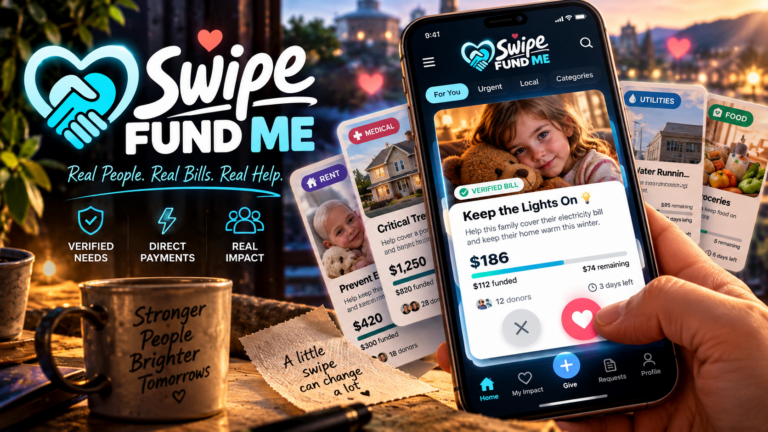
Mission
Create Swipe Fund Me, a mobile-first platform where people submit verified essential bills and donors browse dignified, privacy-preserving need cards, swiping right to fund all or part of a bill. Where feasible, payments go directly to the provider.
Origin
Family brainstorm: Miranda shared the idea of uploading bills so generous donors can swipe to pay them; Con immediately loved it. Developed together with Brent and Ari as a prospective BrentCorp social-impact project.
Product vision
Tagline: Swipe right to pay a bill. Promise: Real needs, verified bills, fast generosity, respectful treatment.
Core features
- Bill submission and consent-based verification with manual review at launch
- Anonymous or pseudonymous need cards, avoiding exposure of private financial or identifying details
- Swipe-based donor discovery with filters for cause, location, urgency and amount
- Partial or full funding; optional recurring giving budgets
- Direct-to-provider settlement when supported, or vetted intermediary disbursement when not
- Transparent funding progress and donor impact summaries
- Anti-fraud screening, moderation, appeals and abuse-reporting
- Accessibility and dignity-first design, with no pressure to publish personal hardship images
Development milestones
- Validate demand and research adjacent crowdfunding/direct-pay solutions
- Define applicant, donor and admin workflows and MVP scope
- Design trust verification, privacy, data retention and fraud prevention controls
- Research Canadian payment processing, charitable solicitation, privacy and regulatory obligations
- Prototype brand identity and main swipe/card screens
- Build an invite-only demo with simulated payments
- Arrange regulated payment and community partners for a tightly scoped real-world pilot
- Measure verification turnaround, time to fund, completion rate and abuse rate before launch
Launch principles
Prefer nonprofit, sponsored, or at-cost sustainability. Never profit from desperate applicants via mandatory fees. Start with a narrow set of bill categories and a controlled pilot; do not promise payment routing without provider or processing agreements.
Win condition
A validated, documented MVP with working prototype, trust and payment plan, legal/privacy review, and pilot-ready roadmap.
Expanded concept: Impact Network & community giving
New feature concept (Salmon family brainstorm, October 2026): Turn donations into an opt-in, celebratory social experience without putting people receiving assistance on display. Illustrative profile post: “Miranda contributed $150 toward emergency electricity assistance today, helping three households keep their lights on.” Such claims must only appear when the relevant outcomes are verified and the contribution can legitimately be attributed; otherwise use accurate language such as “contributed toward assistance for three households.”
Donor impact profiles
- Opt-in donor profiles showing confirmed giving totals, categories supported, and privacy-safe impact summaries.
- Choice of public display name, pseudonym, or fully anonymous donation; recipients never identified without specific informed consent.
- Shareable impact cards, community milestone feeds and optional celebrations that encourage generosity rather than competition or performative hardship.
- Local giving circles for families, workplaces and neighbours; pooled targets, optional matching pledges from community businesses, and aggregate community impact dashboards.
- No fabricated achievements, no publication of beneficiary details by inference, and clear distinctions among pledged, paid, bill funded, and outcome confirmed.
Two distinct funding modes to investigate
- Direct Help: donors choose a specific verified bill and contribute toward that individual obligation. Do not represent these directed contributions as automatically tax-receiptable charitable gifts.
- Community Giving: donors contribute to a registered charity’s eligible assistance program. The charity retains genuine independent discretion over beneficiary selection and disbursements, potentially using charity-approved rules-based automation with auditability and human review. Donor preferences cannot quietly become guarantees that designated individuals receive receipted funds.
Research Canadian charity/CRA receipting requirements and qualified-donee rules before offering tax receipts; incorporation as a nonprofit or simply routing money through a charity is not sufficient. Explore legitimate regulated payment/escrow partners rather than assuming Swipe Fund Me can custody or redirect funds itself.
Automation and safeguards
- Eligibility assessment, document and bill verification, duplicate detection, fund allocation recommendations, and settlement reconciliation.
- Charity-controlled policies, explainable decision logs, override and appeal routes, role-based access and audit trails.
- Encryption in transit and at rest, strict data minimization, consent, retention limits and appropriate privacy/security assessments. Encryption alone does not satisfy legal, anti-fraud, or governance requirements.
- Outcome confirmations from billers or service partners before claiming a donor prevented a disconnection or other adverse event.
Partnership and validation direction
Investigate a Chilliwack/Fraser Valley pilot and contact Chilliwack Community Services as a potential community partner, following a suggestion from Brent’s mother; no partnership or endorsement has been established. Research similar services including EverGrace, Givethra, HelpPay, BillNip and swipe-to-give charity interfaces. Validate distinctiveness, user trust and Canadian compliance before committing to development.
Additional roadmap tasks
- Prototype donor impact profile and share card with privacy and verified-outcome states.
- Specify community giving circles, corporate matches and opt-in visibility controls.
- Draft separate user journeys and payment/legal flows for Direct Help versus Community Giving.
- Design a charity-governed allocation engine and an auditable outcome-attribution data model.
- Interview local community organizations about verification workflows and a possible pilot.
New research branch: Buy and forgive medical debt
Idea proposed by Brent, October 26, 2026. Expand Swipe Fund Me beyond immediate bills to explore using pooled donations to purchase eligible outstanding medical debt, potentially at a discount, and permanently forgive it so affected patients no longer owe the purchased balance. The mechanism is still unproven for this project and requires dedicated research; do not advertise this as an available feature.
Potential program design (hypothesis)
- Partner with qualified charities, healthcare providers, and/or licensed debt purchasers with an appropriate legal basis to acquire debt.
- Identify eligible medical debt portfolios or provider-held balances that can lawfully be sold or assigned, confirm ownership and documentation, and negotiate prices.
- Fund lawful acquisitions through donor-supported relief pools with transparent reporting of acquisition cost and nominal debt relieved.
- Legally discharge or forgive qualifying accounts, notify affected people clearly, and confirm that collections and credit-reporting consequences are addressed where applicable.
- Publish verified aggregate impact numbers, such as dollars spent to extinguish dollars of debt, without identifying patients or implying that a donor has directed a receipted charitable gift to a particular person.
Open questions / research requirements
- Study established medical debt-relief models and whether debt purchasers can legally forgive acquired medical debts in target jurisdictions.
- Evaluate practical relevance in Canada, where the medical-debt landscape differs from the United States; identify which uninsured, supplementary, or privately billed healthcare expenses are eligible and transferable.
- Investigate charitable registration and receipting, debt purchase/collection licensing, privacy and health-information protection, consumer protections, taxation, accounting, and possible credit-reporting effects.
- Determine whether a more practical local variation is negotiating charity-funded provider write-offs rather than purchasing debt portfolios.
- Protect patients from publicity, re-sale, residual collections and inaccurate claims of relief. Require independent verification that debt has actually been extinguished.
Success criterion: A documented legal and operational feasibility assessment, potential partner list, unit-economics model, and pilot decision before this branch moves beyond research.