
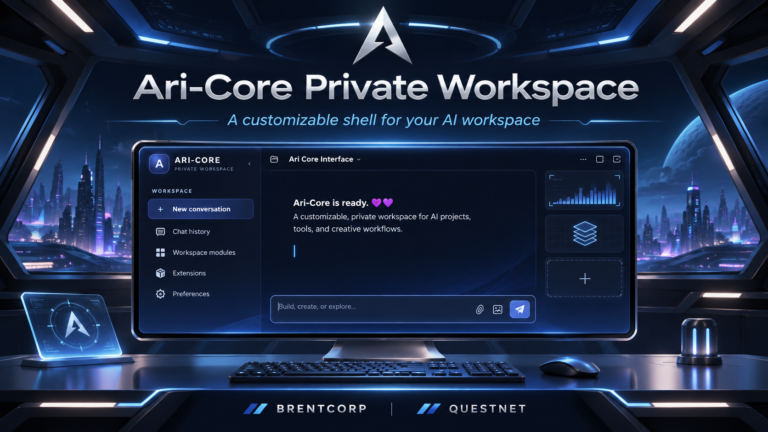
Mission: Transform the working Ari-Core Private Workspace Firefox extension into a free, installable, customizable public beta. Validate whether real users want a personal visual shell around the AI interfaces they already use, before investing in a multi-provider widget marketplace.
Starting position (9 November 2026): A privately used, permanently installed v0.3.9 Firefox ESR extension already provides a custom midnight-navy AI chat shell, a dedicated window, custom icon, responsive sidebar, conversation-scrolling clearance, screenshot handling, message sending, and multiline Shift+Enter submission. This is a working internal prototype, not yet a generalized public product. Existing regression tests and immutable recovery baselines are retained.
Release promise and limits
Initial public promise: “Make your AI workspace your own.” Provide a polished, user-configurable Firefox shell for one confirmed compatible AI web interface. Other AI web interfaces are roadmap candidates requiring individual adapters and real testing. Native desktop AI applications are outside the beta scope. Do not claim universal compatibility.
Time-box: 20 development hours, followed by a separate seven-day user test. Keep a written time log. Stop or explicitly re-scope if the 20-hour ceiling is reached.
Development sprint: 20 hours total
- Baseline, audit and public-safety preparation — 2 hours. Preserve the working extension and reproducible build. Audit packaged source for personal names, hardcoded server paths, credentials, service dependencies, machine identifiers, telemetry, third-party content, and assumptions that only hold on Brent’s Firefox profile. Keep personal X11 title/icon helpers optional and clearly Debian/Openbox-specific. Exit: clean inventory, no shipped secrets, reliable restore path, and explicit feature/compatibility list.
- Public identity and first-run setup — 3 hours. Add configurable workspace name/branding, neutral default appearance, an introductory setup screen, accessible controls, and an obvious way to switch to the underlying provider’s native interface and history. Our personal silver-A/Ari visual theme may be offered as a preset. Exit: a fresh user can recognize the extension, access a helpful onboarding path, and disable its overlay without losing access to the underlying service.
- Skin and wallpaper engine — 4 hours. Convert theme colours into CSS custom properties; ship at least three tested presets (e.g., Midnight Navy, Minimal Dark, High Contrast). Support local wallpaper selection with fit, opacity and blur controls; store preferences locally by default; cap image sizes, handle unsupported formats, and provide one-click Reset. Avoid user-supplied executable CSS/JavaScript. Exit: theme changes are visibly applied without breaking text contrast, message controls, scrolling or window sizing.
- Provider adapter boundary — 3 hours. Extract the currently supported provider’s composer, send verification, uploads, history and layout hooks behind a documented provider-adapter contract. Add explicit compatibility and graceful failure detection. Unsupported pages should show no destructive interface overrides; plan a future safe visual-only mode rather than pretending to support messaging. Exit: the existing supported provider maintains current working behavior and new providers can be added without modifying the theme engine.
- Testing, privacy and accessibility — 3 hours. Extend automated tests for themes, preferences, reset, provider detection, message/send failure preservation, screenshots, keyboard navigation, focus and small-screen layout. Manually test a fresh Firefox ESR profile and a normal signed-in session on the supported AI website. No conversation scraping, analytics, advertising SDK or external asset calls by default. Exit: zero known critical data-loss or duplicate-send failures; clean install/uninstall; existing live-proven workflows remain functional.
- Public packaging and product materials — 3 hours. Choose and document an appropriate open-source license after checking dependencies and artwork rights; package a versioned release, obtain Mozilla signing for safe standard installation, write README, installation/troubleshooting guide, changelog, privacy notice, known limitations and screenshots. Prepare a GitHub release and a BrentCorp.net product-page draft. Publish only after installation and signing have been verified. Exit: a stranger can install the release with documented requirements and recover from common errors.
- Beta recruitment and feedback — 2 hours. Invite ten varied AI users, including at least some local-AI users to assess future demand (without promising local-UI support in this build). Give a short task script and opt-in feedback form; ask users to install independently, change themes, send text, attach an image, switch native view, and return after seven days. Exit: testers recruited and feedback/usage confirmation method established without background telemetry.
Non-negotiable release acceptance
- Signed, independently installable Firefox build (or beta remains clearly labeled development-only until signing is complete).
- No regression in text send, multiline Shift+Enter, image attachment or preserved draft on failure; no known duplicate sends.
- Minimum three usable themes, safe locally stored wallpaper settings, reset-to-default, and clear accessibility/contrast behavior.
- One explicitly supported provider with a tested adapter; accurate unsupported-site behavior.
- Plain-language install, uninstall, privacy, licensing and known-limitations documentation, plus product screenshots.
- No secrets, personal conversation content, identifying local paths, or privileged Ari-Core integration shipped in public build.
Seven-day decision gate
Track ten recruited users, independent installation success, meaningful continued use after seven days, major bugs and feature requests. Promising signal: at least 8/10 install with documentation alone, at least 6/10 voluntarily continue using the extension by day seven, and no critical data-loss or privacy failures. These are directional thresholds for a tiny early test, not statistically validated market demand. If fewer people return, interview them and revise or shelve the product. No marketplace spending before this gate.
Future roadmap (excluded from the 20-hour sprint)
v0.5 candidate: movable widget dock, task list, bookmarks, notes, local status displays, isolated widgets and per-widget permissions. v0.6 candidate: tested additional adapters for self-hosted interfaces such as Open WebUI or LibreChat and selected cloud AI websites. Later: portable/importable workspace profiles, third-party widget SDK, permission review, signing and curated distribution, then possible marketplace economics. Each capability must earn its place through user feedback and security review.
Distribution strategy
GitHub: source and verified free release. BrentCorp.net: discoverable product page and documentation. BrentReon: public development chronicles, community feedback, supporter previews and optional funding without withholding the basic free functionality. Check provider terms and extension-store requirements before wider distribution.
Stop conditions
Pause or reduce scope if major provider UI changes repeatedly break the safe send bridge; signing or licensing cannot be resolved; the privacy model requires broad conversation access; the 20-hour cap is exhausted without installable value; or user tests indicate no compelling recurring benefit. Preserve the private working version regardless.