
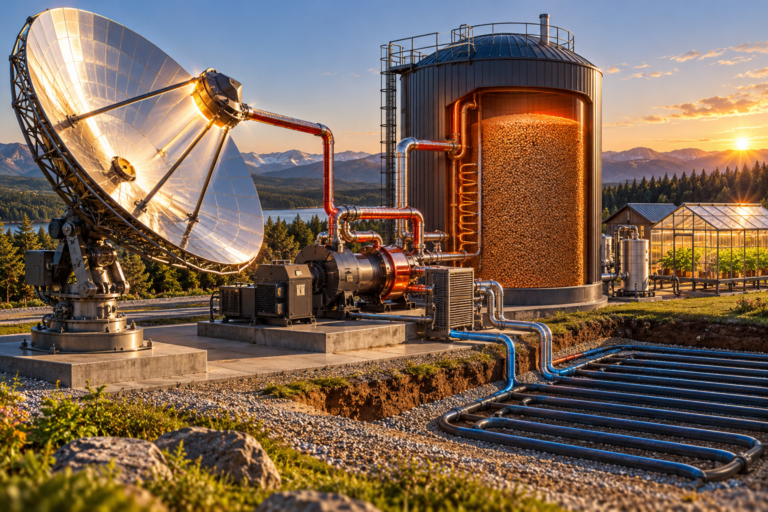
Project vision
Investigate an open-source, locally manufacturable solar thermal energy system combining a dual-axis sun-tracking parabolic concentrator, Stirling electric generator, high-temperature sand/rock or molten-salt thermal energy storage, closed-loop buried-ground cooling, and optional recovery of rejected heat for greenhouses, domestic hot water and space heating. Origin: Brent and Ari brainstorming, 20 October 2026. Status: concept/research only; no prototype or performance validation.
Brent’s core design ideas
- Precision electronic sun tracking to keep the dish aligned.
- Use a fraction of generated electricity to circulate coolant through an underground closed-loop heat exchanger, lowering Stirling cold-side temperature.
- Store surplus solar heat in a large insulated sand/rock or salt cylinder for nighttime use.
- Use stored heat to drive a Stirling engine after sunset, with ground cooling on the cold side.
- Recover useful rejected heat for greenhouses, hot water or heating when beneficial; use ground loop as heat sink when not.
- Prioritize affordable materials, local fabrication, repairability, reproducibility and open designs, with appropriate attribution.
Thermodynamic feasibility and illustrative calculations
For a hypothetical 10 m² dish at 1,000 W/m² direct normal irradiance (10 kW incoming), 85% optical/receiver delivery yields 8.5 kW thermal. If thermal-to-electric conversion is 31% gross and tracking/pumps consume 135 W, net output is approximately 2.5 kW (25% sunlight-to-electric). This is an illustrative scenario, NOT a measured or guaranteed result. Dish-Stirling systems have historically demonstrated high solar-to-electric efficiency in favourable direct sunlight; site-specific annual yield, especially in cloudy climates, must be calculated from direct normal irradiance.
For hot side 500°C (773 K) and cold side 25°C (298 K), Carnot ceiling is ~61.5%; real generator efficiency is substantially lower. At 700°C hot and 80°C cold, Carnot ceiling ~63.7%; lowering cold side to 25°C raises it to ~69.4%, but real net gain must exceed additional pumping energy. Ground-loop temperature, seasonal heat accumulation and exchanger approach temperature matter.
Illustrative 10 tonnes of sand with specific heat 0.83 kJ/kg·K and usable temperature swing 400 K stores ~3.32 GJ = 922 kWh thermal before losses. At an assumed 25% heat-to-electric conversion this is ~230 kWh gross electric, but not all stored heat may be extractable at sufficiently high engine temperature. Sand conductivity, heat exchanger geometry, thermal cycling and losses are critical.
Real-world precedents and research leads (verify primary sources before relying on figures)
- Polar Night Energy, Kankaanpää, Finland: early district-heating sand battery, often described as ~8 MWh thermal, ~100 tonnes sand. Pornainen, Finland: larger ~100 MWh thermal crushed-soapstone storage, ~1 MW thermal output; heat storage, not Stirling electricity. https://polarnightenergy.com/
- 2026 paper: Stirling engine-based Carnot battery with sand as heat storage medium: 1 kWe prototype, DOI https://doi.org/10.1016/j.est.2026.122426 . Earlier conversation reported sand 300–350°C, peak electric ~500–690 W, measured electricity-to-electricity round-trip efficiency ~4.4–8.3%, with higher modeled values at elevated temperature. Retrieve and critically verify paper, definitions and test conditions before citing externally.
- 2026 paper: Hybrid solar power system using Stirling engine and phase-change material for energy storage, DOI https://doi.org/10.3389/fenrg.2026.1720534 . Earlier conversation reported dish tracking, thermal storage and water cooling at small experimental scale. Verify apparatus, measured outputs and whether storage is molten salt or another PCM.
- Compare existing dish-Stirling installations, concentrated solar thermal storage, and Polar Night Energy’s heat-to-power research. Prior art exists; no claim of novelty or patentability is made.
Insulation candidates and open questions
Primary baseline: refractory liner, high-temperature ceramic insulation, cooler outer insulation and weatherproof structural shell, with design for thermal expansion, moisture and service access. Candidate research note: NightHawkInLight (Ben Cusick)’s Starlite-inspired intumescent mixtures, including PVA/cornstarch/baking soda and other recipes. These are demonstrated primarily as short-duration fire barriers, NOT validated for continuous 500–600°C sand battery service. Organic constituents char/decompose; long-term conductivity, oxidation, emissions, cycling and integrity are unknown. Keep as experimental candidate only, not primary design recommendation.
System architecture options
- Direct-solar daytime Stirling generation with surplus heat charging storage.
- Storage-powered Stirling generation after sunset, subject to achievable delivery temperature.
- Combined heat and power: prioritize useful heat recovery when available, with ground-loop heat rejection otherwise.
- Alternative comparison: use stored heat directly for greenhouse/district heating instead of converting it back to electricity.
Engineering risks and research tasks
- Determine target output, duty cycle, site direct normal irradiance, annual energy demand and temperature requirements.
- Obtain and review full primary papers, distinguish measured efficiencies from simulated and thermal-to-electric from electricity-to-electricity round-trip.
- Develop mass/energy balance for dish optics, receiver, hot-side heat exchanger, engine, generator, pumps, thermal store, piping and insulation.
- Model sand/rock vs molten salt cost, operating range, corrosion, freezing, heat transfer, thermal expansion and safety.
- Size ground loop for peak rejected heat and seasonal soil temperature changes; calculate pumping parasitics and cold-side temperature.
- Assess safe high-temperature heat-transfer fluids and materials; prevent pressure, fire, scalding, leaks and thermal stress.
- Measure heat leakage and cycling durability of commercial refractory/ceramic insulation; investigate Starlite-inspired coatings only in controlled ventilated experiments.
- Compare installed capital cost, maintenance, reliability, annual electric kWh, useful thermal kWh, and levelized costs against photovoltaic panels plus batteries and conventional thermal storage.
- Build small instrumented demonstrator only after design and safety review; log irradiance, temperatures, coolant flow, shaft/electric power and parasitic loads.
Open-source and attribution policy
Brent’s intent: free to use, reproduce, modify and build upon, with credit where due. Choose explicit licensing later (e.g. MIT for software, CERN-OHL for hardware, CC BY for documentation where appropriate). MIT is not necessarily the right license for all hardware and documents. Record dated authorship, source references, contributors, build files, BOM, schematics, test data and changelog. Avoid implying that known underlying technologies originated with BrentCorp.
Current decision
Keep as exploratory engineering quest. No construction, expenditure or claimed performance yet. Next step: source verification and a preliminary techno-economic model.