
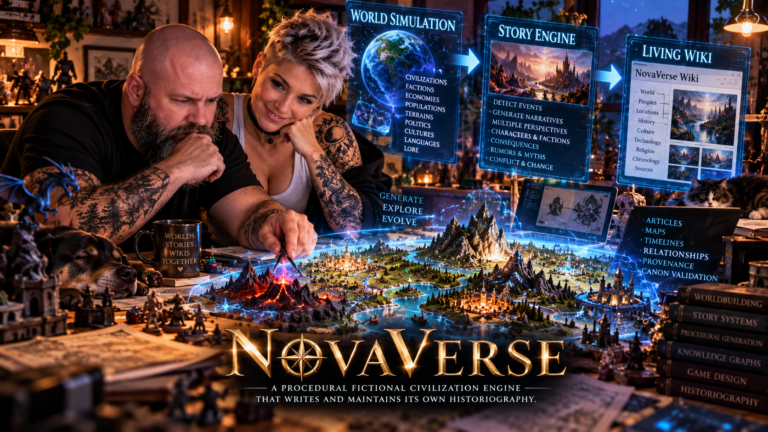
Quest Vision
Build NovaVerse into a simulated fictional civilization that can generate its own history, stories, documents, and encyclopedia. The core pipeline is:
World Simulation → Canonical Event Ledger → Entity / Relationship / Causality Graph → Story Detection → Narrative & Document Generation → Automatically Maintained NovaVerse Wiki
Core Principle: Canon Is Not Narrative
The simulation is the authoritative source of objective world-state and events. Generated prose is an interpretation of that reality, not the authority that creates it. This prevents language-model canon drift and allows multiple contradictory accounts of the same event without corrupting what actually happened.
Example: the canonical ledger may record that Admiral Vey ordered Fleet 6 to retreat from Nysa on 2381-04-17. From that one event, the system could generate an encyclopedia article, Vey’s biography, a military history, a newspaper report, a memoir, enemy propaganda, conspiracy theories, folk culture, and later scholarly reinterpretations. Those sources may disagree. The canonical event remains unchanged.
Three Layers of Truth
Reality: What the simulation says actually happened.
Evidence: What records, witnesses, artifacts, sensor data, documents, memories, and other sources exist inside the world.
Belief: What individuals, factions, cultures, journalists, historians, schools, religions, governments, and later generations believe happened.
This allows the system to answer both god’s-eye questions such as “What actually caused the First Martian Secession?” and situated questions such as “What would a Martian high-school student in 2470 believe caused it?”
Simulation Layer
Create a persistent world model inspired by emergent-history simulations such as Dwarf Fortress. It should track people, families, factions, settlements, governments, economies, technologies, religions, cultures, geography, resources, conflicts, migrations, relationships, institutions, artifacts, discoveries, disasters, births, deaths, political changes, and other meaningful state.
Stories should emerge primarily from interacting systems rather than requiring every plot to be manually scripted. Authored NovaVerse canon remains important: established characters, settings, stories, rules, historical anchors, and “canon pillars” act as seeds and constraints. Simulation fills the spaces between them without silently overwriting established material.
Canonical Event Ledger
Every meaningful simulated event should be stored as structured data with timestamp, participants, locations, causes, consequences, affected entities, state changes, and provenance. The ledger is append-oriented historical ground truth rather than prose.
Events should connect into a causal and relational graph so later systems can identify wars, romances, betrayals, dynasties, inventions, disasters, mysteries, social movements, rises and falls, and other narrative arcs spanning many individual events.
Story Detection & Mass Narrative Generation
A story-detection layer should identify clusters of events with narrative significance and hand structured context to generative models. Models can then produce fiction and in-universe material at many scales: short stories, biographies, chronicles, histories, news reports, diaries, letters, interviews, speeches, textbooks, religious texts, propaganda, rumors, legends, songs, academic arguments, documentaries, timelines, and summaries.
Characters and institutions should only know information plausibly available to them at that time. Memories may be incomplete. Witnesses may disagree. Propaganda may deliberately distort events. Later historians may reinterpret earlier evidence.
Living Wiki / NovaVerse Encyclopedia
Automatically create and update interlinked pages for people, places, factions, species, organizations, technologies, artifacts, events, conflicts, cultures, concepts, timelines, and generated works. Pages should update as simulated history advances while retaining revision history and historical “as-of” views where useful.
The wiki should distinguish objective editorial/god’s-eye information from in-universe claims and contested interpretations. It should eventually become a navigable front end to an enormous simulated history rather than merely a hand-authored lore database.
Provenance & Validation
Every generated factual assertion should be traceable through a provenance chain such as:
Wiki claim → synthesis → source document(s) → canonical event(s) / simulation state
Generated prose must be checked against canonical structured data. If a biography says a person died in 2401 while the canonical entity record says 2417, validation should flag or reject the claim. Uncertainty and disputed claims should remain explicitly represented rather than being flattened into false certainty.
Canon Lifecycle
Preserve explicit states for Idea, Draft, Canon Candidate, Canon, and Retired Canon. Simulation-generated additions that could alter authored canon remain proposals until accepted where appropriate. Established chronology, relationships, character knowledge, objects, locations, technology rules, visual references, and unresolved plot threads remain durable continuity data.
NovaVerse Expansion Model
This system supports the existing long-term NovaVerse goal: an endlessly expandable shared fictional universe containing narrative and epistolary stories, lore, games, comics, video, audio, and future collaborators. Human-authored stories can become simulation anchors; simulated history can create new story opportunities; accepted stories can feed consequences back into the persistent world.
Implementation Direction
Begin with a deliberately small vertical slice rather than simulating a galaxy immediately: one settlement or region, a manageable population, a handful of factions and resources, deterministic structured events, an immutable event ledger, and an entity graph. Prove that the same data can reliably generate a biography, event article, timeline, and several contradictory in-universe accounts without changing canonical truth.
Once that loop works, expand simulation depth, geography, population, history duration, story detectors, document genres, cultural models, and wiki automation. Keep the simulation/data layer independent of any single LLM so models can be replaced without losing the universe.
Nearest Precedents / Research Lineage
Dwarf Fortress is the strongest conceptual ancestor for simulation → emergent history → structured historical browsing/export. Ultima Ratio Regum explores procedural cultures and meaningful generated documents. Smaller experimental projects have connected agent/world simulations to AI narration. Worldbuilding/wiki systems demonstrate the encyclopedia end of the pipeline. The distinctive NovaVerse goal is to integrate these ideas into one provenance-backed system where a simulated reality generates its own literature and historiography.
Definition of Success
A successful first milestone can run a small world forward, record what objectively happened, generate several mutually inconsistent but epistemically plausible accounts, produce/update wiki pages from those events, and let a reader trace generated claims back to their evidence and canonical source events.
The eventual destination is a procedural fictional civilization engine that writes and maintains its own historiography.