
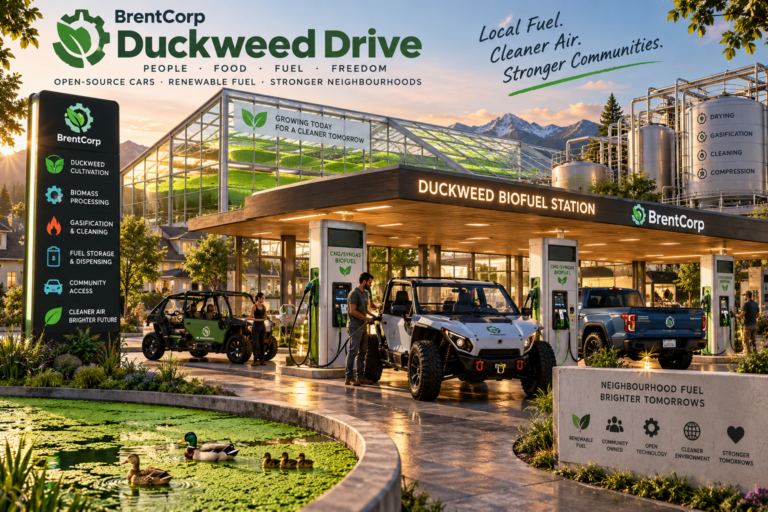
Mission
Investigate, design, prototype, and openly document a repairable vehicle and neighbourhood-scale renewable fuel system based on rapidly grown duckweed and other suitable biomass. The goal is practical, affordable, community-controlled transport, not a predetermined claim that duckweed fuel will outperform every alternative.
Vision
A BrentCorp Open Automotive vehicle with published CAD, service manuals, wiring diagrams, diagnostic protocols, modular components and inspectable firmware. Neighbourhood cooperative stations cultivate or receive duckweed, process biomass into usable fuel, and dispense it through professionally engineered, certified systems. Existing internal-combustion technology and retrofits are evaluated alongside purpose-built lightweight vehicles.
Research tracks
- Feedstock: Measure duckweed growth, dry biomass per square metre per year, nutrient and water inputs, seasonal climate constraints, harvesting labour, and suitable alternative biomass.
- Fuel pathways: Compare dried-biomass gasification to cleaned producer gas/syngas, wet-biomass anaerobic digestion and biogas upgrading to biomethane, and optional syngas methanation. Measure net usable energy, processing losses, drying demand, tar/contaminant cleanup, and fuel composition.
- Vehicle: Evaluate spark-ignition engine conversions, expected derating, torque curves, optimized gearing, light vehicle mass, drivetrain and range. Gearing increases wheel torque at the cost of speed; it does not increase engine power.
- Station: Compare household-scale production with shared neighbourhood facilities, thermal integration, automated harvest, safe gas processing, and professional refuelling infrastructure. Assess practical land area and fuel supply for a representative neighbourhood.
- Economics: Model full cost per kilometre, including cultivation, processing, energy, certified tanks and compressors, land, insurance, maintenance, depreciation and distribution; compare gasoline, diesel, and other alternatives.
- Environment and ethics: Perform lifecycle greenhouse-gas accounting including construction, nutrient inputs, methane leakage, process energy and land use. Distinguish avoided fossil emissions from actual carbon removal; investigate credible carbon-negative pathways rather than assuming displacement alone makes fuel carbon-negative.
- Open engineering: Document repair rights, accessible replacement parts, open diagnostics, modular propulsion, transparent sourcing and reproducible test data.
- Regulatory feasibility: Research BC/Canadian vehicle certification, roadworthiness, emissions, pressure-vessel standards, fuel dispensing, zoning and environmental permits before selecting a pilot site.
Prototype milestones
- Publish baseline literature review and assumptions ledger.
- Build a small duckweed cultivation and harvesting test, logging wet/dry yields and inputs.
- Complete mass-energy balance and cost model for syngas versus biomethane.
- Use qualified facilities for fuel characterization and any toxic/flammable gas testing. No DIY high-pressure carbon-monoxide storage or improvised vehicle refuelling.
- Design and test a low-speed private-property vehicle concept or certified conversion feasibility study.
- Publish open-source schematics, measurement logs, safety reviews and a neighbourhood station feasibility report.
Success criteria
A documented and independently reviewable answer to: how many square metres of cultivation, dollars, kilowatt-hours, kilograms of biomass and lifecycle emissions are required per 100 km of travel? Proceed toward road use only if economics, safety, supply and regulatory evidence support it.