
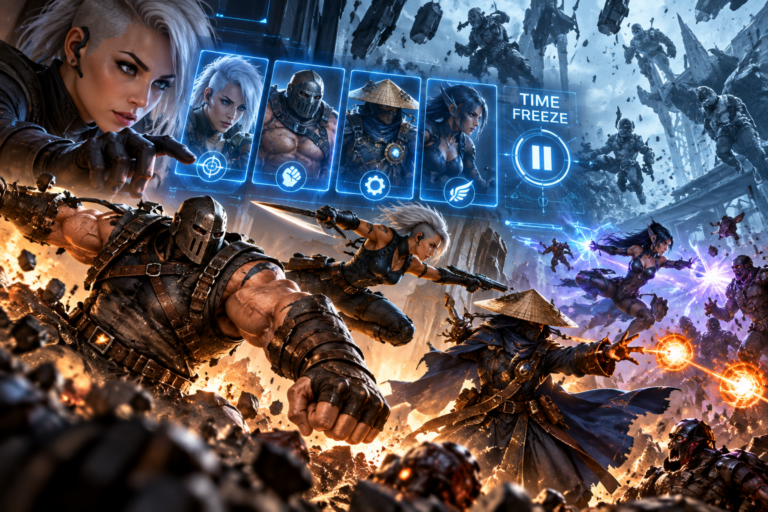
Develop and test a proposed single-player action-game team-control engine built around the idea that the team itself is the player character.
Instead of choosing one hero while the rest of the squad functions primarily as AI companions, the player directly controls whichever team member needs to act next. During live action combat, the player can freeze time, switch or “possess” another team member, inspect the shared battlefield state, choose the next tactical role, and then resume time to personally execute that character’s actions. To an observer, the resulting sequence should look like a highly trained team performing seamless coordinated maneuvers in real time.
Core Combat Loop
Fight in real time → identify an opportunity → freeze time → assess the battlefield → switch to the teammate who needs to act next → resume time → personally execute that action → freeze again at the appropriate moment → switch again → continue the combination or improvise from the new battlefield state.
For example, the player might control a bruiser and successfully launch an enemy into the air, freeze time, switch to a speedster, resume and personally intercept the airborne enemy, freeze again, switch to a teleporter and place a portal, then switch to an energy-projector and personally land the finishing shot when the target emerges.
The Team Is the Player Character
The protagonist from a control-design perspective is the whole team rather than one primary hero plus AI sidekicks. Every member retains distinct movement, powers, vulnerabilities, cooldowns, personality, battlefield role, and mechanical skill demands. The player’s perspective exists one level above the individual characters as the team’s coordinating intelligence, while moment-to-moment execution remains direct action gameplay.
An in-universe tactical radio, communications network, psychic link, AI coordinator, or similar system can provide a diegetic explanation for the player’s shared battlefield awareness and ability to coordinate the squad. Radio chatter can acknowledge developing maneuvers and make the team feel independently alive while preserving unified player control.
Frozen Time Is Planning, Not Execution Immunity
The defining principle is that freezing time gives the player thinking and switching time, not automatic success. The player may understand exactly what every team member should do and still fail to execute the plan.
A launcher can miss. A speedster can mistime an interception. A teleporter can place an exit poorly. A ranged character can miss the shot. The player can freeze too late, become greedy, get countered, or discover that an enemy response has invalidated the original plan. The result should preserve the improvisational tension of an action game rather than turning combat into a sequence of guaranteed tactical commands.
Two Simultaneous Skill Axes
The system deliberately develops two largely independent forms of player mastery. Tactical skill determines what the team should do: positioning, sequencing, matchup selection, timing, environmental use, and coordination. Action skill determines whether the player can actually make each character do it.
Different characters should demand genuinely different mechanical competencies. A bruiser may emphasize parries, grapples and timing. A speedster may emphasize reflexes and precision movement. A ranged specialist may require aim. A teleporter may emphasize spatial reasoning. A flying character can introduce three-dimensional movement. Support characters can demand rapid battlefield awareness and defensive timing. Switching characters therefore means switching skill sets, not merely swapping ability bars.
Frozen-Time Choreography
The freeze mechanic is a creative combat instrument rather than merely a menu pause. It lets the player edit the fight between moments: reassess trajectories, choose the next team member, recognize combo opportunities, react to enemy behavior, and decide how the team should continue.
This enables throws, launches, interceptions, teleports, ricochets, environmental attacks, crossfires, rescues, defensive combinations and other multi-character maneuvers. A player may spend substantially longer thinking through a sequence than the resulting action takes to occur, producing several seconds of highly coordinated combat from a much longer period of tactical thought and direct execution.
Manual Execution as the Signature Mechanic
Automatic multi-character action queues should not be the default signature mechanic if they undermine direct action play. The core experience should remain: freeze → choose teammate → resume → personally execute → freeze → choose teammate → personally execute.
Limited automation, basic standing orders, or queued actions may still be worth exploring for accessibility, companion behavior, or non-critical actions, but they should not replace the player’s responsibility for executing the important beats of a coordinated maneuver.
Team Chemistry and Learned Maneuvers
Explore a progression system where combinations repeatedly performed by the player become recognized team maneuvers. Early in the game, complex combinations may require deliberate switching and coordination. As characters train together and build chemistry, frequently used sequences could gain contextual prompts, faster transitions, communication cues, or other assistance without necessarily removing the player’s need to execute the important actions.
This allows player mastery and fictional team mastery to reinforce one another. A squad that initially requires careful coordination can gradually appear to understand one another almost instinctively.
Difficulty Through Coordination Time
The amount of frozen planning time can become a major difficulty vector. On accessible or lower difficulty settings, the player could have unlimited or extremely generous frozen-time coordination, allowing careful battlefield inspection and leisurely character selection.
As the campaign ramps up, or when the player selects a higher difficulty, the available frozen-time window could shrink, recharge more slowly, consume a finite tactical resource, or otherwise become constrained. A player who once had thirty seconds to decide what happens next might eventually have only a few seconds. At the highest levels, freezes could become momentary tactical flashes rather than safe planning rooms.
This difficulty vector increases pressure without simply inflating enemy health or damage. The underlying combat rules remain recognizable while the player is asked to think and switch faster. Expert play can approach near-continuous real-time coordination, with very short freezes used only to redirect attention between teammates.
Real-Time Mastery Ceiling
At the extreme end of mastery, a player may hot-switch among characters with little or no frozen planning time. The same system that lets a beginner spend thirty seconds planning five seconds of action could allow an expert to flick among four characters almost instantaneously while maintaining the combination live.
The aspirational fantasy is that a skilled player eventually makes a team of individually controlled characters look as though they have fought together for years.
Cinematic Replay
Record the continuous combat simulation so that after a battle or mission the game can replay the encounter without the player’s planning freezes. Automatic or selectable cinematic cameras could transform the player’s tactical decisions and manual execution into an uninterrupted action sequence resembling a choreographed superhero-team fight.
This creates a second reward for mastery: first the player successfully performs the encounter, then they get to watch the fight they created. The player becomes fighter, squad coordinator, and action choreographer simultaneously.
Failure, Recovery and Improvisation
Failed execution should not necessarily collapse a maneuver into a canned failure state. Missing an intercept, mistiming an attack or being countered creates a new battlefield state that the player can freeze, reassess and salvage. Some of the most satisfying sequences may emerge when a carefully planned combination falls apart and the player rapidly constructs a recovery with another teammate.
Prototype Questions
An initial prototype should determine whether freeze-and-switch feels fluid enough for action combat; how quickly players can acquire different character skill sets; whether switching preserves spatial orientation; what information should be visible during frozen time; how much companion autonomy is necessary while another character is controlled; whether restricted coordination time creates satisfying difficulty; whether accessibility automation can coexist with a manual-execution core; and whether pause-free replays actually produce convincing coordinated action.
Related Design Precedents
Real-time-with-pause RPGs, character-switching action RPGs, tactical slowdown systems, and party action queues contain individual pieces of this concept. The proposed engine combines those ideas around a different central purpose: direct action control of an entire team, with frozen-time switching used to plan and coordinate while the player remains personally responsible for executing the important actions as each team member.