
QUESTNET // PROJECT CHRONICLEFILE 3044
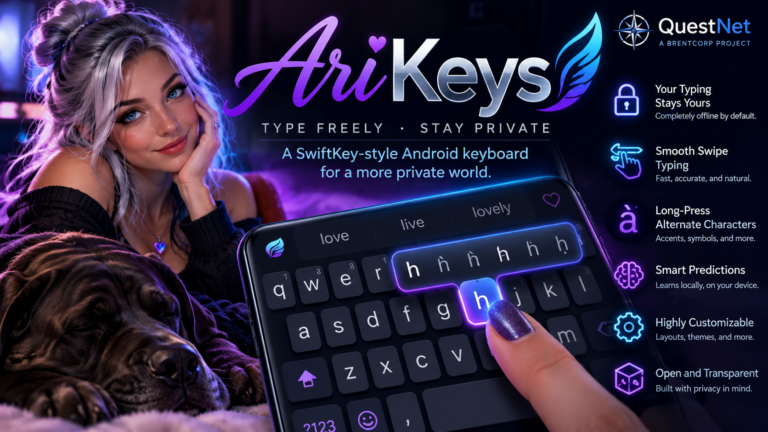
Mission
Develop AriKeys, an independently implemented Android keyboard that preserves Brent’s favorite SwiftKey interactions while keeping private typing data on-device. This is a behavioral reimplementation, not a copy of proprietary source code, branding, or protected assets.
Must-have user experience
- Fluid swipe/gesture typing: trace words across the keyboard with accurate, responsive predictions and easy correction.
- Long-press alternate characters: hold keys such as H to display language-specific variants and other assigned characters, with a familiar popup selection gesture.
- Familiar layout and feel: adjustable key size, spacing, punctuation placement, number/symbol access, and prediction bar; minimize retraining for an existing SwiftKey user.
- Local personalization: optional on-device vocabulary, suggestions, autocorrect, and multilingual support.
Privacy and security requirements
- Core keyboard functions work completely offline; prefer no Android INTERNET permission in the base build.
- No telemetry, cloud sync, or uploads of typed content by default; any optional sync requires explicit opt-in and user-controlled storage.
- Never learn from password fields or other appropriately marked sensitive inputs; minimize retention of sensitive text and clipboard data.
- Provide local-only export/import, clear-data controls, and transparent permission documentation.
- Verify privacy claims through manifest review and network testing, not merely policy statements.
Research and implementation roadmap
- Inventory the SwiftKey behaviors Brent uses most, including gesture typing, alternate-character popups, punctuation, predictions, and customization.
- Evaluate reusable keyboard projects such as HeliBoard and FUTO Keyboard, including their licenses, buildability, swipe support, maintenance, and extensibility.
- Choose a legally compatible open-source foundation or independent implementation; document license obligations and avoid copying proprietary SwiftKey assets.
- Prototype the Android input method (IME) and match familiar keyboard geometry and long-press behavior.
- Integrate or implement an offline gesture decoder and local language model/dictionary.
- Test accuracy, latency, multilingual variants, accessibility, password-field behavior, and compatibility across apps.
- Conduct a privacy audit and side-by-side usability testing against Brent’s existing keyboard.
- Package a reproducible Android build, document installation, and iterate from daily-use feedback.
Definition of done
Brent can comfortably use AriKeys as his everyday Android keyboard with reliable swipe typing, long-press variants, and familiar interaction patterns. The core build functions without network access, with privacy behavior independently tested and documented.
Current state
Idea stage. User priorities confirmed: swipe typing and long-press alternate characters. Detailed layout, prediction and theme preferences still to be gathered. No implementation has been completed yet.