
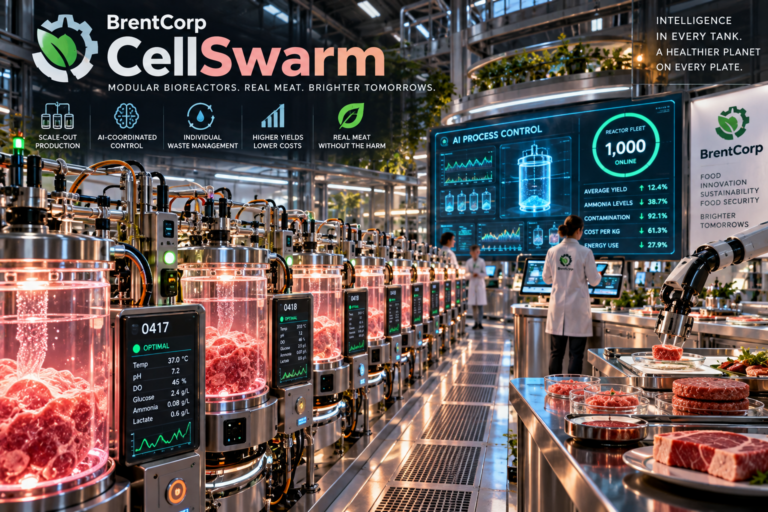
Mission
Investigate whether cultivated meat can be produced more reliably and economically by scaling out into hundreds or approximately 1,000 small, independently monitored and controlled bioreactors rather than relying exclusively on a few giant vessels. Each reactor would have its own nutrient circulation and metabolic-waste management, while a supervisory AI coordinates optimization across the fleet.
Origin
Brent conceived this architecture after watching a cultivated-meat documentary around 2023 that discussed ammonia buildup and challenges of scaling large bioreactors. The idea remained on his mind for roughly three years before he and Ari revisited it in October 2026. Initial investigation suggests parallel small bioreactors and automated bioprocess control already exist separately, so novelty of the combined implementation must be assessed rather than assumed.
Architecture
- Autonomous reactor modules: Each vessel gets sensors for pH, dissolved oxygen, temperature, nutrient and waste proxies, flow and contamination indicators, with local deterministic control and alarms.
- Independent media handling: Per-reactor nutrient circulation, controlled medium exchange and appropriate ammonia/lactate management; evaluate membrane perfusion, filtration and waste-treatment options without assuming filtration alone removes dissolved ammonia.
- Fleet intelligence: Supervisory analytics compare reactor performance, detect anomalies, forecast harvest times, and recommend bounded process adjustments. Safety-critical controls remain independently validated.
- Modular serviceability: Quick-replace validated modules, contamination isolation, traceable batches, shared sterile media preparation and harvesting where economically beneficial.
- Continuous learning: Conduct controlled experiments across subsets of reactors, preserving independent replicates, statistical validity, and quality assurance.
Questions to answer
What is the optimal vessel size and count? Can independent waste control improve cell density or reliability? Do contamination isolation and staggered harvesting outweigh extra pumps, tubing, sterile connections, cleaning, labour and capital expense? Which cell types and cultivated-meat stages suit modular scale-out? What improvements, if any, does AI deliver over conventional process control?
Research and development milestones
- Review prior art: parallel bioreactors, perfusion systems, ammonia/lactate management, cultivated-meat production, modular biomanufacturing and AI process control.
- Model one large vessel versus medium-scale banks versus many small vessels at equal total working volume and comparable operating targets.
- Develop mass balances for nutrients, ammonia, lactate, oxygen, carbon dioxide, water and cells; estimate media, energy, consumables, sterilization, labour and equipment costs.
- Build a digital twin and simulated control architecture before wet-lab experiments.
- Prototype a small array using an appropriate nonhazardous model culture in a properly equipped laboratory; test sensors, control stability, failure isolation and repeatability.
- With qualified cell-culture collaborators, validate relevant cultivated-meat cells, food safety and quality requirements, and economic scalability.
- Publish reproducible results, open-source controller specifications and a commercial feasibility assessment.
Success criteria
Compare cost per kilogram of safe usable product, yield per litre, batch failure rates, labour hours, energy, medium consumption, contamination events and downtime against equivalent conventional architectures. Document negative results as rigorously as positive ones.